RobotsHelp

Author: Pete

  • ChatGPT for Client Communication Templates That Sound Like You

    A client asks where the project stands, and a four-line answer somehow eats twenty minutes, because the news is not great and the tone has to be just right. You can use ChatGPT for client communication templates to fix that: teach it how you write once, save a template for each client moment that keeps coming back, and fill in the facts each time. You still read and send every email yourself.

    Imagine it is Wednesday, 4:50 pm, the developer just told you the launch slips a week, and five minutes later a calm, honest email to the client sits in your drafts with the new date and one clear question.

    Want a practical AI lesson like this every week? Join free.

    No password needed – your reset opens instantly.

    No password. Just your email, and you’re in.

    Short answer: put your style notes and your template prompts in a ChatGPT Project, so every chat for client mail starts with the same context. OpenAI’s own help page describes Projects exactly that way: related chats, files and instructions kept together, with project instructions that apply to every chat inside that project (Projects in ChatGPT). This page is about the client moments that repeat. For quick answers to whatever lands in your inbox, use our guide on drafting reply emails faster with ChatGPT. For emails to new prospects, see ChatGPT for sales outreach sequences.

    Why a prompt template beats a saved email

    A saved email is fixed text. The first time a client reads it, it sounds fine. The third time, they notice. A blank ChatGPT chat has the opposite problem: it knows nothing about you, so you explain your tone, your client and your rules all over again.

    A prompt template sits in between. It fixes the parts that should never change (structure, tone, length, what you never promise) and leaves the facts open in [brackets]. The wording changes with every situation. The quality does not.

    That is the whole idea behind client communication templates in ChatGPT: you are not saving emails, you are saving the instructions that write them.

    Step 1: Teach ChatGPT how you write (once, about ten minutes)

    1. In ChatGPT, select New project in the sidebar and call it something like “Client emails”.
    2. Find three to five client emails you sent and liked. Take out names, prices and anything confidential.
    3. Paste them into a chat inside the project with the prompt below.
    Here are [3 to 5] emails I sent to clients. I am a [your role, e.g. freelance designer / project manager / consultant].
    
    Describe my writing style in 5 short bullet points: sentence length, greeting and sign-off, how direct I am, words I use often, and things I never do.
    
    [paste the emails]

    Why real emails? Examples steer the model better than adjectives like “friendly but professional”. OpenAI’s prompt guide calls this few-shot prompting: you include a handful of examples and the model picks up the pattern (Prompt engineering guide).

    Now open the project’s Project settings (the ••• menu) and paste this as the project instructions, with your style bullets filled in:

    You help me write emails to my clients.
    
    My style: [paste the 5 style bullets]
    
    Rules for every draft:
    - Under 150 words unless I ask for more.
    - Lead with the point. No "I hope this email finds you well".
    - End with one clear ask or next step.
    - Never invent dates, prices, names or promises. If a fact is missing, write [CHECK] in its place.
    - Give me 3 subject lines above the draft.

    The [CHECK] rule is the one that saves you. Instead of guessing a delivery date that sounds plausible, ChatGPT leaves a visible gap you cannot miss when you read the draft.

    A quick word on privacy: in Settings, under Data controls, you can turn off “Improve the model for everyone” so new chats are not used to train OpenAI’s models. On ChatGPT Business and Enterprise, workspace content is not used for training by default (Data controls in ChatGPT). Even then, leave out anything your contract says stays private.

    Step 2: Save client communication templates for the moments that repeat

    Most client mail falls into a handful of moments. Each one gets its own short prompt, saved in the project. Below are the five that tend to cost the most time, because the tone matters as much as the facts. Weekly status updates are a sixth; we cover those in Gemini for automated status updates, and the same approach works in ChatGPT.

    Telling a client about a project delay

    This is the email people put off, and putting it off makes it worse. A good delay email gives the news in the first line, the reason in one sentence, the new date, what you are doing about it, and what you need from them. No paragraph of apologies before the point.

    Template: DELAY
    Client: [name, role]
    Project: [project]
    Old date: [date]  New date: [date]
    Reason (plain, one line): [reason]
    What we are doing about it: [action]
    What I need from them: [decision or "nothing, just keeping you informed"]
    Tone: honest and calm. One short apology, not three.

    Here is the kind of draft that comes back (example only, yours will follow your own style):

    Subject: Launch moves to 21 October
    
    Hi Sam,
    
    The site launch moves from 14 to 21 October. The payment test failed on mobile, and I'd rather fix it now than launch with it. Sorry for the shift.
    
    The fix is in progress and I'll send you a test link on the 17th.
    
    One question: do you want to keep the 14th for the newsletter, or move it with the launch?
    
    Best,
    Pete

    A follow-up email after a client demo call

    The best time to send it is while the call is still fresh for both of you. Paste your rough call notes (or a transcript summary, see how to summarize meeting notes with ChatGPT) and let the template turn them into a short recap.

    Template: DEMO FOLLOW-UP
    Client: [name, company]
    My call notes: [paste]
    Write a follow-up that:
    1. Thanks them in one line, no gushing.
    2. Repeats the 2 or 3 things THEY cared about most, in their words.
    3. Answers any open question from the call, or marks it [CHECK].
    4. Confirms the next step we agreed, with a date.
    Attach or link: [deck / proposal / recording]

    Point 2 is what makes it land. A recap of what you showed is about you. A recap of what they asked about shows you listened.

    Scope change (“could you also just…”)

    Template: SCOPE CHANGE
    Client request: [what they asked for]
    Original scope: [one line]
    Extra time or cost: [CHECK if unknown]
    Write a reply that says yes to the idea, explains in one sentence that it is outside the current scope, and offers two options: (a) add it now with the extra time/cost, or (b) park it for phase 2. Friendly, no defensiveness.

    A payment reminder that keeps things warm

    Template: INVOICE REMINDER
    Invoice: [number], [amount], due [date], [X] days ago
    Level: [1 friendly / 2 clear / 3 final]
    Payment link: [link]
    Assume it was simply missed at level 1. Give the facts first, offer to resend the invoice, under 80 words, no guilt.

    Chasing an approval or feedback

    Template: APPROVAL CHASER
    Waiting for: [what you need approved]
    Sent on: [date]
    What happens if we wait: [impact on timeline]
    Ask for a yes/no or a date they can give feedback by. Make it easy to answer in one line.

    Subject lines for client follow-up emails

    Your project instructions already ask for three subject lines, but they are worth a second look. The subject should tell the client what is inside and what you need, before they open it. “Quick update” says nothing. “Launch moves to 21 October” says everything.

    If none of the three fit, ask in the same chat:

    Give me 5 more subject lines for this email. Under 50 characters each. Put the key fact (date, decision, number) in the subject. No "just checking in", no "quick question".

    The two-minute routine once your templates exist

    1. Open a new chat inside your “Client emails” project.
    2. Type the template name (DELAY, DEMO FOLLOW-UP…) and paste the facts.
    3. Read the draft. Search it for [CHECK] and fill every gap yourself.
    4. Check names, dates and amounts against your own records.
    5. Copy it into your own email and send it from there.

    When you rewrite a draft a lot, paste your final version back and ask ChatGPT to update that template so the next one starts closer. You can also save a response you like as a project source, so it is there for future chats in the same project (OpenAI explains how here). After a few rounds, most drafts need only small edits.

    For a one-off email that is not a template yet, like a tricky note you wrote in a hurry, our guide to making an email sound more professional shows how to polish it before it goes out.

    Want the reminders to go out on a schedule instead of from memory? Pair these templates with a no-code flow from our guide on automating follow-up emails without code.

    What ChatGPT should never decide for you

    • Dates, prices and promises. That is what the [CHECK] rule is for. A confident wrong date in a client email is worse than a late email.
    • Anything contractual. Changes to terms, refunds or liability go past you (and maybe your lawyer), not just past ChatGPT.
    • Whether it should be an email at all. A big delay or a budget overrun often deserves a phone call first. Use the template for the written follow-up after the call.

    If the same client questions keep landing in a shared inbox, the next step up from templates is a support agent that drafts the routine answers for you. See how to automate customer support with AI agents.

    FAQ

    Can I do this on the free ChatGPT plan?

    Projects are available to signed-in ChatGPT users, depending on your plan and workspace settings, and the free plan allows 5 files per project (Projects in ChatGPT). That is enough for a style guide and a page of templates. If Projects are not available to you, keep the templates in a note and paste the right one at the start of a chat. It works the same, with one extra paste.

    Should I paste real client names?

    You can write [CLIENT] in the chat and add the name in your own email client. It costs you five seconds and keeps names out of ChatGPT. Check your Data controls setting either way.

    Does this work in Claude or Gemini too?

    Yes. The same style notes and templates work as a pasted prompt in any assistant. Only where you store them changes.

    How many templates do I need?

    Start with the one email you dreaded most this month. Add the next one the next time a moment repeats. Five good templates beat thirty you never open.

    When the client email is really a full bid, switch to ChatGPT for proposal writing for freelancers and draft the scope, price, and next step in one pass.

    Want the next practical AI lesson for your desk? Join free.

    No password needed – your reset opens instantly.

    No password. Just your email, and you’re in.

    When the ticket queue needs clearer answers, see also best ChatGPT prompt for answering customer questions.

    When the work is a content calendar and captions instead of client emails, see also ChatGPT prompts for social media manager work.

    When the client message is a public Google review rather than an email, see how to use AI to respond to Google reviews for a draft-and-check routine that keeps the reply short and honest.

  • ChatGPT for Sales Outreach Sequences: A Desk Guide

    You can use ChatGPT for sales outreach sequences by designing a short multi-step outbound plan (first touch, value follow-up, soft close), then asking ChatGPT to draft each step from real facts about the prospect, not from vague hype.

    Imagine it is 9:15 am, your CRM shows twelve new leads from last night, and in the next twenty minutes you have a three-email sequence ready for each one, personalized, still in your voice, waiting for your send button.

    No password needed, your reset opens instantly.

    No password. Just your email, and you’re in.

    Short answer: treat ChatGPT as your sequence writer, not your auto-sender. You bring the offer, the proof, and the prospect notes. ChatGPT turns that into step 1, step 2, and step 3 emails you still review. OpenAI’s own prompt guide is a solid baseline for clear instructions and output format (Prompt engineering). This page is about outbound sequences. It is not about inbox replies, and it is not a Zapier-only automation walkthrough.

    What a sales outreach sequence is (and is not)

    A sequence is a planned set of touches over a few days. Typical shape for desk sellers:

    1. Day 0, short first touch with one clear reason you wrote.
    2. Day 2 or 3, value follow-up (a tip, a case snippet, or a useful question).
    3. Day 5 to 7, soft close or break-up note that leaves the door open.

    If you need faster replies to mail that already landed in your inbox, use our guide on how to use ChatGPT to draft reply emails faster. If you want timed reminders that create drafts without rewriting the copy yourself every time, pair this page with automate follow-up emails and the free Zap examples in Zapier free plan automation examples.

    Build the sequence skeleton before you prompt

    Many people find ChatGPT drafts get mushy when the prompt asks for “a good sales sequence” with no constraints. Lock the skeleton first:

    • Audience (role, company type, one pain you can name).
    • Offer in one sentence (what they get if they reply).
    • Proof you already have (case study line, metric you trust, customer quote).
    • Length (e.g. under 120 words per email).
    • Tone (calm, direct, no hype).
    • Number of steps and the gap between them.

    Then paste that into ChatGPT and ask for subject lines plus bodies for each step. Keep one reusable “sequence brief” Doc so you do not rebuild the rules every morning.

    Best ChatGPT prompts for B2B sales follow up

    Use a prompt that forces facts and forbids invention:

    You help me write B2B follow-up emails for a 3-step outbound sequence. Audience: [role] at [company type]. Offer: [one sentence]. Proof I can use: [paste only real lines]. Output: Step 1, Step 2, Step 3. Each step: subject + body under 120 words. Tone: calm and specific. Do not invent metrics, logos, or meeting history. If a fact is missing, leave a [BRACKET] for me to fill.

    For a single follow-up after no reply, shorten it:

    Write one follow-up to the email below. Mention the original ask in one line. Add one new useful angle from my notes. Under 90 words. No guilt language.

    Then paste your first email and your notes. Review names, dates, and any number before you send.

    Zapier new CRM lead trigger to draft outreach email with ChatGPT

    You can wire a new CRM lead into a ChatGPT draft so the sequence starts when the lead appears, while you still own the send.

    1. Trigger: New lead or new contact in your CRM (HubSpot, Pipedrive, or similar via Zapier).
    2. Action: ChatGPT (or OpenAI) with a fixed prompt that includes the sequence brief plus the lead fields (name, company, source, notes).
    3. Action: Create a draft in Gmail or save the text back to a CRM note. Do not auto-send on day one.

    Zapier’s ChatGPT integrations page lists the connector options if you want the official map of triggers and actions (ChatGPT integrations on Zapier). Keep the Zap on “draft only” until you trust the prompt. For more desk-friendly Zap shapes on the free plan, see Zapier free plan automation examples.

    ChatGPT: turn a case study into a short sales email

    Case studies are long. Outreach emails are short. Ask ChatGPT to cut, not to invent:

    Turn the case study text below into one short sales email for [role]. Keep: the problem in one line, the change in one line, and one proof line I already wrote. Max 110 words. Subject line options: 3. Do not add new numbers.

    Paste only the case study sections you trust. If the study is a long PDF, summarize it first with a tool you already use, then feed the short summary into this prompt. Our Claude report guide can help when the source is a heavy document: how to use Claude AI to summarize a long report and extract action items.

    Best ChatGPT prompt to analyze a sales CSV

    Upload or paste a clean export (remove emails you should not share if the chat is not private enough for your team rules). Then ask for patterns you can act on this week:

    Analyze this sales CSV. Columns mean: [list them]. Tell me: 1) top 5 accounts by open opportunity value, 2) leads with no touch in 7+ days, 3) a suggested sequence priority list (who first, why). Output a table. Do not invent rows. If a column is unclear, ask one clarifying question.

    Use the priority list as the input for your outreach sequence drafts. ChatGPT is reading the sheet. You still decide who gets mail today.

    ChatGPT prompts for sales rep daily tasks

    A light daily stack many reps can reuse:

    • Morning triage: “From these CRM notes, list who needs a first touch, who needs follow-up 2, and who should wait. One line reason each.”
    • Sequence draft: the B2B follow-up prompt above for your top three names.
    • Call prep: “Turn these notes into a 5-bullet call sheet: goal, open question, proof line, likely objection, next step ask.”
    • End of day: “Summarize today’s sends and replies into three CRM update lines. No fluff.”

    If your day also includes handoffs (sign-ups, suppliers, bookings), the email handoff patterns in how to use Grok Bot email for work handoffs pair well with the same habit of short, factual prompts.

    A simple 3-step sequence you can paste today

    Step 1 (first touch): why them, why now, one ask.

    Step 2 (value): one tip or a one-line case result, same ask restated.

    Step 3 (soft close): permission to close the loop, plus an easy reply option (“yes, send the one-pager” works better than a calendar dump).

    Ask ChatGPT to fill each step from your brief. Then read every name and every claim out loud once. If a line sounds like a brochure, cut it.

    The one mistake that wastes the sequence

    Vague prompts make vague outreach. “Write a cold email sequence that converts” without audience, proof, and length often invents confidence around empty claims. OpenAI’s prompt engineering guide stresses clear instructions and a defined output shape for a reason (Prompt engineering).

    Protect yourself: only paste facts you already trust, name the reader, cap the word count, and keep send under your control. ChatGPT drafts the sequence. You own the relationship.

    A weekly ritual that sticks

    1. Update your sequence brief (offer, proof, tone) once a week.
    2. Export or filter leads that need a first touch or a follow-up.
    3. Run the B2B follow-up prompt for a small batch (five to ten names).
    4. Review, personalize one line per email, queue or send.
    5. Log what got replies so next week’s brief gets sharper.

    After a few weeks the brief is the hard part, and ChatGPT becomes a cleanup step for the words.

    No password needed, your reset opens instantly.

    No password. Just your email, and you’re in.

    Once a prospect replies, keep the tone consistent with reusable ChatGPT for client communication templates that sound like you, not like a generic AI draft.

    Before a lead even gets a sequence, you can let a no-code AI agent for lead qualification in n8n or Zapier score and route new sign-ups, so your outreach goes to the people most likely to reply.

    When a warm lead asks for a written offer, use ChatGPT for proposal writing for freelancers to turn the call notes into a clear scope and price they can say yes to.

    If outreach is one part of a bigger push, shape the campaign first with our ChatGPT prompts for marketing campaign ideas, so every step of the sequence tells the same story.

    Once the sequences are running, your deal list grows fast. Our ChatGPT prompts for sales pipeline management give you a weekly review kit to spot stalled deals and decide the next step for each one.

    Before you build a full sequence, get the first email right. Our ChatGPT prompts for cold email outreach walk you through writing a short first touch that sounds like you, not a template.

    Before you write the sequence, you need someone to send it to. Here is how to use AI for lead generation and build that list.

  • Gemini for Automated Status Updates: Desk Guide

    You can use Gemini for automated status updates by feeding it this week’s facts (a Sheet row, meeting notes, or a short bullet list), then letting Help me write turn them into a client or leadership email you still review before you send.

    Imagine it is Thursday at 4:40 pm, your status mail is due in twenty minutes, and the numbers already sit in one Sheet row while Gemini drafts the first pass so you only fix tone and send.

    No password needed – your reset opens instantly.

    No password. Just your email, and you’re in.

    Short answer: keep a living source of truth (usually a Google Sheet), ask Gemini in Sheets to summarize the week, then paste that summary into Gmail’s Help me write with a clear audience and tone. Google’s own Help me write guide is the official path for drafting in Gmail (Draft emails with Gemini in Gmail). This page is about that weekly habit, not about auto-sending mail without you.

    Never used Gemini before? Start with our Gemini tutorial for beginners, then come back here for the weekly status routine.

    What “automated” really means here

    Gemini does not replace a human send button for status mail. What it does well is the boring middle: turn scattered updates into a clean first draft.

    1. Source, one place that already holds progress, blockers, and next steps (Sheet, Doc, or thread).
    2. Summarize, Gemini in Sheets or Docs pulls the week into a short brief.
    3. Draft, Gmail Help me write turns that brief into the email your reader needs.
    4. You decide, you check names, numbers, and tone, then send.

    If you mainly need faster replies to mail that already arrived, start with our guide on how to use ChatGPT to draft reply emails faster. If your bottleneck is meeting notes, use how to use ChatGPT to summarize meeting notes and feed the action list into the same status habit.

    Set up a status Sheet Gemini can read

    Create one tab with columns you can fill in under five minutes: Date, Workstream, Done this week, Blockers, Ask, Next week. Keep one row per workstream, not a novel.

    Then open Ask Gemini in Sheets and ask for a plain summary of the selected rows. Google documents summarizing a spreadsheet from the side panel in Collaborate with Gemini in Google Sheets. For a cell-level summary you can also use the AI function, for example a one-line takeaway per row, as shown in Use the AI function in Google Sheets.

    Many people find a Friday morning fill-in (or Thursday if Friday is travel day) is enough. The Sheet is the automation. Gemini is the writer.

    Draft the status email in Gmail with Help me write

    Open Compose, click Help me write, and give Gemini the audience, the facts, and the length. Google’s Workspace Learning Center walks through the same flow for work email (Use generative AI at work).

    Paste your Sheet summary and add lines like:

    • Write a project status update email to the client for Project Atlas.
    • Keep it under 180 words.
    • Sections: Done, Blockers, Decisions needed, Next week.
    • Tone: calm and direct, no hype.

    Then use Refine (Formalize, Shorten, Friendly) until it sounds like you. Insert the draft, fix any number that feels off, and send.

    ChatGPT email templates for project status updates to clients

    If your team lives in ChatGPT more than Gemini, the same structure still works. Paste the Sheet bullets and use a template like this:

    You are helping me write a client status update. Audience: [client name]. Facts only from the bullets below. Output: subject line + short email with Done / Blockers / Ask / Next week. Do not invent metrics.

    Then paste your bullets. Keep one template for “all green” weeks and one for “we need a decision” weeks so you do not rewrite the skeleton every Friday.

    ChatGPT prompts for marketing status updates to leadership

    Leadership updates need a different cut. They care about outcome, risk, and ask, not every channel detail.

    Prompt pattern many marketers reuse:

    Write a marketing status update for leadership. Lead with the one outcome that moved this week. Then: 3 bullet wins, 1 risk, 1 decision needed, next week’s focus. Max 150 words. Facts only from my notes:

    Swap Gemini or ChatGPT as the drafting engine. The job stays the same: protect the reader’s time.

    Gemini: status update emails from Google Sheets data

    When the Sheet already holds this week’s numbers, ask Gemini in Sheets to summarize the range, copy that brief, and hand it to Gmail Help me write. That is the practical version of “Gemini automate status update emails from Google Sheets data” without pretending Gmail sends itself.

    If you later want a timed reminder or a draft created on a schedule, pair the Sheet with a simple Zap or calendar block. Our desk examples for free Zapier flows live in Zapier free plan automation examples.

    AI tools to write status updates faster (honest pick)

    For Google Workspace teams, Gemini in Gmail + Sheets is usually enough: the data and the mailbox already sit together. ChatGPT is strong when your notes live outside Google. Claude is strong when the source is a long report (see how to use Claude AI to summarize a long report and extract action items). Pick the tool that already sees your source of truth. Switching apps every week costs more time than it saves.

    If your team is still deciding which assistant to standardise on, see ChatGPT vs Gemini vs Copilot for which one fits Google Workspace, Microsoft 365 or a mixed setup.

    The one mistake that wastes the draft

    Vague prompts make vague status mail. “Write my weekly update” without facts, audience, or length often invents a confident tone around empty bullets. Google’s own tips say to make Help me write prompts specific (who, subject, tone, and the facts you want included) in the Gmail Help me write article above.

    Protect yourself: only paste numbers you already trust, name the reader, and keep a hard word limit. Gemini drafts. You own the send.

    A Friday ritual that sticks

    1. Update the Sheet (five minutes).
    2. Ask Gemini in Sheets for a week summary.
    3. Open Gmail Help me write with audience + sections + word limit.
    4. Refine once, check names and numbers, send.
    5. Copy the same email into your project Doc if leadership wants a paper trail.

    After a few weeks the Sheet is the hard part, and the email becomes a cleanup step.

    When a single meeting needs its own write-up for leadership, use the same idea to turn your meeting notes into a report with ChatGPT.

    When you have to write a longer report for work, not a weekly update, here is how to get ChatGPT to help write a report for work, from the first outline to a check before you send it.

    Status updates are easier when the project started with a clear plan. Here is how to use AI to create a project plan with tasks, owners and dates you can report against.

    No password needed – your reset opens instantly.

    No password. Just your email, and you’re in.

  • Zapier Free Plan Automation Examples for Desk Work

    You want Zapier free plan automation examples you can run this week without a developer or a credit card. This guide sticks to what Zapier’s Free plan actually allows: two-step Zaps, 100 tasks a month, and simple desk workflows that save real minutes.

    Imagine it is Monday at 9:10. A form fill lands, a Slack ping goes out with the lead details, and a Gmail draft is waiting for your review before you finish your coffee.

    No password needed, your reset opens instantly.

    No password. Just your email, and you’re in.

    Short answer: on Free, build one trigger and one action per Zap, keep volume under about 100 successful actions a month, and start with form-to-Slack, sheet-to-email, or labeled-mail-to-draft paths. Zapier’s own Free plan help page lists those limits clearly (100 tasks, unlimited Zap workflows, two-step Zaps only). Multi-step ChatGPT-plus-Gmail chains usually need a paid plan, so this page shows free-tier shapes first, then an honest ChatGPT path.

    What Zapier’s Free plan actually includes

    Before you copy a fancy template from the internet, check the ceiling. According to Zapier’s Free plan overview, Free gives you:

    • 100 tasks per month shared across Zap workflows (and MCP actions if you use them).
    • Unlimited Zap workflows, tables, and forms as assets, with Free Zaps limited to two steps (one trigger + one action).
    • 15-minute polling for Zaps that check for updates on a schedule.
    • One user on the account.

    A task is counted when an action step runs successfully. Triggers and some built-in helper steps often do not count the same way. If you are unsure whether a step will burn a task, test once and watch the task counter in Zapier.

    Premium apps and multi-step Zaps sit on paid plans. That is fine. Free is for learning the habit and covering light desk volume, not for a full sales machine.

    Zapier free plan automation examples you can build today

    Each example below is intentionally two steps so it fits Free. Swap Gmail for Outlook if that is your inbox. Test with your own email or a dummy form first.

    1) New form lead → Slack (or Teams) alert

    1. Trigger: New Typeform, Tally, or Google Form response.
    2. Action: Send a Slack channel message with name, email, and the question they asked.

    Why it helps: you stop refreshing a form inbox during deep work. One ping, then you reply when you choose.

    2) New spreadsheet row → create a Gmail draft

    1. Trigger: New row in a Google Sheet (status = “needs reply”).
    2. Action: Create a Gmail draft with a short template and the sheet fields mapped in.

    You still send the message yourself. That human gate keeps tone and promises safe. If you want stronger reply drafting habits first, see how to use ChatGPT to draft reply emails faster.

    3) Labeled email → add a calendar block

    1. Trigger: New Gmail email with label “schedule”.
    2. Action: Create a Google Calendar event (or a 15-minute focus block).

    Use this when mail turns into “I need time to do this” instead of a one-line answer.

    4) New Drive file in a folder → email yourself a link

    1. Trigger: New file in a shared Drive folder (for example “Client uploads”).
    2. Action: Send yourself (or a teammate) an email with the file name and link.

    Useful when clients drop files and you do not want to live in Drive notifications.

    5) New calendar event → Slack reminder to prep

    1. Trigger: New Google Calendar event (or event starting soon, if your trigger supports it on Free).
    2. Action: Post a Slack DM to yourself with the title and a one-line prep checklist.

    Keep the checklist boring: open notes, pull the last email, write three questions. Automation should cue the habit, not invent the meeting.

    When the Free plan is enough (and when it is not)

    Free is usually enough if:

    • You run a handful of light Zaps under roughly 100 actions a month.
    • Each workflow is truly two steps (trigger → one action).
    • You are fine with ~15-minute polling for apps that do not push right away.
    • Only you need to edit the Zaps.

    You will outgrow Free when you need a chain such as form → filter → ChatGPT draft → Gmail draft → CRM note, or when several people must share and edit the same automations. At that point, compare paid Zapier against Make rather than stacking awkward two-step workarounds.

    For longer follow-up sequences with waits and stop rules, see our guide to automate follow-up emails without code. That page is about the sequence habit. This page is about Free-tier Zap shapes.

    Zapier free plan examples with ChatGPT email automation

    People search this because they want “new lead → AI writes email → draft in Gmail.” On Zapier Free, that full chain is usually more than two steps, so it does not fit as one Zap.

    What still works on Free:

    • Trigger → ChatGPT (OpenAI) action as a learning Zap. Example: new form response → ChatGPT “Write an Email” or Conversation. You read the output in the Zap run history and paste it into mail yourself.
    • Trigger → Gmail draft with a fixed template (no AI in the Zap), then improve the body in ChatGPT in a separate tab before you send.
    • Two separate Free Zaps only if each stays two steps and you accept a manual handoff between them. Do not pretend that is elegant. It is a bridge until you upgrade.

    Zapier documents how to connect the ChatGPT (OpenAI) app with an OpenAI API key and prepaid API billing (see How to get started with ChatGPT (OpenAI) on Zapier). That connection is separate from a ChatGPT Plus subscription. Company policy still wins: if client mail cannot leave your workspace, keep AI out of the live path.

    How to connect ChatGPT to Zapier for sales automation

    Use this checklist when you are ready to wire ChatGPT into a sales-related Zap (Free for a two-step test, paid when you need multi-step):

    1. Create an OpenAI API key and enable prepaid billing in OpenAI if required for the models you pick.
    2. In Zapier, add a connection to ChatGPT (OpenAI) and paste the API key.
    3. Pick a sales trigger you already trust: new form lead, new Sheet row, or new CRM note (CRM apps may be premium).
    4. Choose a ChatGPT action such as Conversation or Write an Email. Put hard rules in the prompt: no invented prices, no fake dates, use [NEED FROM ME] when a fact is missing.
    5. On Free, stop at that action and review the run. On a paid multi-step plan, add Gmail “Create Draft” next, then you send.

    Keep the first sales Zap low risk. Drafts beat auto-sends until the prompt sounds like you. If desktop agents and file-heavy office work matter more than mail Zaps, compare options in best AI agent for desktop workflows in the office.

    Zapier vs Make.com for small business automation

    You do not need both. For most solo professionals and small teams:

    • Zapier: gentlest start, huge app list, clear Free on-ramp with two-step Zaps. Good when you want a template and a working ping this afternoon.
    • Make.com: visual scenarios and routers, often nicer when you already know you need branching (if replied, stop / else send).

    Pick Zapier Free if you are learning automation and your first jobs are simple alerts and drafts. Pick Make when the diagram in your head already has branches. Switch only when a real limit (steps, volume, or cost) forces the move.

    Booking is a good example of a job with branches. Our guide to an AI agent for appointment booking automation builds the same flow in n8n and Make, so you can compare them on one real task.

    Limits and gotchas before you scale

    • Two-step ceiling: Filters, formatters, and delays after the first action usually need multi-step (paid).
    • Task math: 100 tasks sounds large until a Zap fires on every email. Start narrow (one label, one form, one sheet tab).
    • Polling delay: Free polling can take up to about 15 minutes. Even apps that feel near real-time still depend on how the trigger is built.
    • Premium apps: Some popular CRMs and tools sit behind paid plans. Check the app badge before you design a week of work around it.
    • Human review: Auto-send is fine for low-risk status notes. Keep drafts for pricing, complaints, and anything that could become a record.

    Selling online? Pair these Zaps with the five ecommerce email automations most shops set up first.

    FAQ

    Do I need a no code automation course for ChatGPT Zapier workflows?

    Not to start. Build one two-step Zap this week, watch the task counter, then add ChatGPT as a single action when you understand the trigger data. A structured path helps later when you want prompts, safety habits, and multi-tool desk workflows in one place. RobotsHelp Launchpad is the free on-ramp for that kind of practice.

    Can Zapier email automation write email drafts with ChatGPT on Free?

    Partly. Free can run trigger → ChatGPT and show you the draft in the Zap history, or trigger → Gmail draft with a template. A single Zap that does trigger → ChatGPT → Gmail draft is multi-step, so plan on paid Zapier (or a manual paste step) for that full path.

    Should I automate CRM updates from every email on Free?

    Usually not as the first project. Syncing CRM fields from full email threads is a different, heavier question (often multi-step and premium apps). Start with alerts and drafts. Keep CRM auto-updates for a later article once volume and permissions are clear.

    You do not need a perfect automation stack. You need one Free Zap that fires reliably, a task budget you understand, and a human check before anything sensitive leaves your outbox. When the update itself is the bottleneck, not the trigger, see Gemini for automated status updates for a Sheets-to-email status flow.

    No password needed, your reset opens instantly.

    No password. Just your email, and you’re in.

    When the Zap only sends the message and you still need the words, pair it with ChatGPT for sales outreach sequences so the copy is ready before the trigger fires.

    When you are ready for those CRM auto-updates, our walkthrough of n8n CRM automation for small business covers four no-code workflows that keep contacts, emails, and deals up to date.

    If your Zap needs to chase a proposal you already sent, use our step-by-step on automating proposal follow-up emails with Zapier.

    If you would rather build in Make than Zapier, our step-by-step on automating client onboarding with Make.com shows a no-code onboarding flow from signed deal to welcome email.

    If the emails piling up are supplier invoices, our n8n workflow for automatic invoice processing reads each PDF attachment from Gmail into one Google Sheets row, so you check rows instead of typing them.

    Running Zaps for several clients at once? Our comparison of n8n vs Zapier for agency workflows shows where the Free plan limits start to bite and which tool fits each client.

    If most of your Zaps start in the inbox, see these email automation examples for eight email workflows in Zapier, n8n and your mail app, from sorting and flagging to chasing replies.

    Ready to add an AI step to one of these Zaps? Our guide to Zapier AI automation shows two builds you can copy, a Slack summary and an AI follow-up email in Gmail.

    Still deciding which job to hand over first? Our guide to AI automation for small business ranks what to automate first, so your Free plan tasks go to the work that saves the most time.

  • Automate Follow-Up Emails Without Code: Desk Guide

    You do not need a developer to automate follow-up emails without code. Pair a no-code tool (Zapier, Make, or n8n) for timing with an AI draft for the message body, then keep a human check before anything sensitive goes out.

    Imagine it is Tuesday morning, two proposals still sit unanswered from last week, and by lunch a polite reminder has already gone out on schedule while you stayed in your real meetings.

    No password needed, your reset opens instantly.

    No password. Just your email, and you’re in.

    Short answer: pick a trigger (form fill, CRM stage, or a row in a sheet), add a wait, draft or send the follow-up, then stop the sequence when they reply or book. Zapier’s own delay docs show how a fixed wait before the next action is the core of scheduled follow-ups (Add delays to Zap workflows). This page is about that sequence habit, not about writing one-off replies by hand.

    What “automate follow-up emails without code” really means

    Follow-up automation is a small loop you can draw on a napkin:

    1. Trigger, something happened (lead form, proposal sent, meeting booked, status changed).
    2. Wait, give them time to answer on their own (often 1 to 3 days).
    3. Message, send a short, useful reminder, or create a draft for you to approve.
    4. Stop rules, if they reply, book, or unsubscribe, the sequence ends.

    That is different from drafting a single reply in ChatGPT when a message lands. One-off drafting helps you answer faster. Sequence automation helps you stop forgetting the second and third touch. If you mainly need faster replies to mail that already arrived, start with our guide on how to use ChatGPT to draft reply emails faster.

    Many people find a three-touch cadence is enough for desk work: day 0 (first send), day 2 or 3 (gentle nudge), day 7 (last soft close). Keep each note short and specific. Long sales essays do not belong in a reminder.

    Pick a tool: Zapier, Make, or n8n

    You do not need all three. Pick one that matches how you like to build:

    • Zapier, gentlest start, lots of templates, Delay steps for waits. Fine for a simple form, wait, then email path.
    • Make, visual scenarios with Sleep or schedule modules, handy when you want routers (if replied, stop / else send).
    • n8n, more control for sheet-based lead lists and auto-stop-on-reply patterns (for example watching the inbox and marking a contact STOP).

    For most office professionals, Zapier or Make is enough for the first sequence. Switch only when you hit a clear limit (branching, volume, or cost). The best AI tool to automate lead follow-up is usually the stack you already trust for mail plus a delay tool, not a shiny new app.

    Build the first sequence in one afternoon

    Use this shape. Swap Gmail for Outlook if that is your inbox.

    1. Trigger: new Typeform / Tally / Google Form submission, or a new row in a leads sheet with status “awaiting reply”.
    2. Optional filter: only continue if they opted in and the topic matches your offer.
    3. Delay: wait 48 hours (Zapier Delay For, Make Sleep, or n8n Wait).
    4. Check: look up whether they already replied or booked (CRM field, sheet status, or calendar event). If yes, stop.
    5. Send or draft: Gmail / Outlook send, or create a draft labeled “follow-up review” if you want a human gate.
    6. Log: write “follow-up 1 sent” and a next date back to the sheet or CRM.
    7. Repeat once: another wait (often 4 to 5 more days), same check, second message, then stop.

    Test with your own email first. Send yourself the whole path before you point it at real leads. Cap the sequence at three to five touches. More than that starts to feel pushy for warm desk work.

    ChatGPT prompts for sales follow up emails

    Use AI for the body, not for inventing facts. Paste context, ask for a short draft, then edit names and promises. OpenAI’s prompt guidance stresses clear instructions and examples over vague asks (OpenAI prompt engineering guide).

    You help me write a follow-up email for desk work.
    
    Context:
    - Who they are: [role / company]
    - What I already sent: [proposal / intro / meeting notes link]
    - Desired outcome: [short call / yes-no on scope / confirm next step]
    - Days since last contact: [n]
    - Tone: warm, plain, no hype, under 120 words
    
    Hard rules:
    - Do not invent prices, dates, or commitments I did not give.
    - One clear ask at the end.
    - No guilt language (“just checking in again…” is fine once, not three times).
    - If a fact is missing, write [NEED FROM ME].
    
    Write subject + body only.

    Save variants for “after a proposal”, “after a discovery call”, and “last soft close”. For meeting-led follow-ups, pull clean decisions first with ChatGPT meeting note summaries, then feed those bullets into the prompt so the reminder cites real next steps.

    When the follow-up sits next to other handoffs in your inbox, a dedicated email agent habit can help keep owners and open loops clear. See how to use Grok Bot email for work handoffs.

    Stop rules that keep you professional

    Automation without stop rules is how you send a “just floating this again” note after they already said no. Build these exits before you turn the sequence on:

    • They replied (any direction).
    • They booked a call or meeting.
    • They unsubscribed or asked to be removed.
    • Your sheet or CRM status is STOP / WON / LOST.

    n8n’s public templates show the same idea: watch the inbox, match the sender, mark STOP so later sends skip them. Whatever tool you use, the sequence must read that status before every new send.

    Honest limits (read before you scale)

    No-code follow-up is not a substitute for judgment:

    • Do not auto-send legal, pricing, or conflict-heavy messages without a human draft gate.
    • Do not scrape or cold-blast people who never opted in. Stick to warm leads and clear permission.
    • Do not promise delivery times your delay tool cannot keep (Zapier delays need the Zap left on).
    • Do not treat AI copy as final. Skim for wrong names, wrong offers, and tone that is not yours.

    If your company forbids pasting client mail into third-party AI tools, keep AI off the live path. Write templates yourself, or use an approved workspace tool, and let the no-code layer handle only timing and logging.

    If your follow-ups go to shop customers rather than clients, start with these email automation flows for ecommerce instead.

    FAQ

    What is the best AI tool to automate lead follow-up?

    For most desk professionals, the best setup is a delay tool you already use (Zapier or Make) plus ChatGPT or your work AI for drafting the body. Dedicated sales sequences make sense once volume is high. Start with one warm list and three touches before you buy another platform.

    Can I fully auto-send, or should I keep drafts?

    Auto-send is fine for low-risk reminders with fixed language (for example “still happy to send the one-pager?”). Keep a draft-and-approve step for custom pricing, complaints, or anything that could become a record in a dispute.

    How is this different from a newsletter sequence?

    Newsletters broadcast the same content to a list. Follow-up automation is person-triggered: one lead, one wait, one check for a reply, then stop. Different need, different build.

    You do not need a perfect funnel. You need one trigger, one honest wait, a short message that sounds like you, and a stop rule that respects a human reply. For the recurring status note to your manager or client, see Gemini for automated status updates.

    Ready for short, practical lessons that fit real desk work?

    No password needed, your reset opens instantly.

    No password. Just your email, and you’re in.

    If you are wiring follow-ups through Zapier on a free tier, see our companion walkthrough of Zapier free plan automation examples for desk-ready two-step Zaps.

    When follow-ups sit inside a longer sales sequence, use our desk guide on ChatGPT for sales outreach sequences to draft the touches before you automate the send.

    For the wording of client updates, apologies, and status notes before you automate the send, keep a set of ChatGPT for client communication templates you can paste into ChatGPT.

    To decide which leads deserve a follow-up at all, set up a simple AI agent for lead qualification first, then let these follow-ups run only for the leads it marks as a fit.

    When the follow-up is for a proposal you already sent, walk through how to automate proposal follow-up emails with Zapier so the reminders leave your desk on a schedule.

    Follow-ups are one job among many in your inbox. For more ideas you can build this week, from sorting mail to flagging urgent messages and sending weekly reports, see these email automation examples.

  • How to Use Claude AI to Summarize a Long Report and Extract Action Items

    You finished reading a 40-page report and still do not have a clean list of who owns what by Friday. This guide shows how to use Claude AI to summarize a long report and extract action items so you leave with a short brief and a dated task list, not another pile of highlights.

    Imagine it’s 2:15 pm, the board pack is open on one screen, and in the next few minutes you have a one-page summary plus a table of owners, deadlines, and open questions instead of scrolling the same PDF again.

    Try the free Launchpad

    No password. Just your email, and you’re in.

    Short answer

    Upload or paste the report into Claude, ask for a summary by section plus a separate action-item list with owner, due date, and priority, then check names and dates before you share it. Anthropic’s own guidance on when to use extended thinking and research is useful when the document is long and the ask is multi-step: give Claude a clear structure, not a vague “make this shorter.”

    What this is for (and what it is not)

    This is for the long file that lands on your desk: a vendor review, a strategy pack, a compliance memo, a research dump. You need the story in plain language and a list of next steps someone can act on.

    It is not a replacement for reading the sections that matter for a decision you will sign. Claude helps you map the document fast. You still own the judgment call.

    If your input is a meeting transcript rather than a formal report, start with our guide on how to use ChatGPT to summarize meeting notes. Same habit, different document shape.

    Before you open Claude: clean the input

    Two minutes of prep saves a messy summary.

    • One document at a time. Do not paste three PDFs into one chat unless you say which one is primary.
    • Strip the noise. Cover pages, blank slides, and appendix dumps can stay out of the first pass if they are not needed for the brief.
    • Name the audience. “Summary for my manager who has 5 minutes” produces a different output than “summary for the project team that already knows the background.”
    • Say what “action item” means for you. Owner + verb + deadline beats a vague “follow up on this.”

    Step-by-step: summarize the report

    1. Open Claude and start a new chat.
    2. Upload the PDF or paste the text. If the file is very large, paste the table of contents first and ask which sections matter for your goal, then upload those sections.
    3. Use a prompt that forces structure. Example:

    Summarize this report for a busy professional who has not read it. Use this format:

    1) One-paragraph overview (max 80 words)
    2) Key findings by section (bullet list, one line each)
    3) Risks or unknowns called out in the document
    4) Decisions the document asks for (if any)

    Stay faithful to the text. If something is missing, say “not stated.” Do not invent numbers.

    Read the overview first. If it misses the real point of the report, tell Claude what was wrong in one sentence and ask for a revised overview only. Fix the frame before you chase action items.

    Step-by-step: extract action items

    Once the summary looks fair, run a second prompt in the same chat so Claude keeps context:

    From the same report, extract action items only. Output a markdown table with columns: Action, Owner (or “unassigned” if not named), Due date (or “not stated”), Priority (high/medium/low based on wording in the report), Source section.

    Rules: every action must start with a verb. Do not turn background findings into tasks. If the report implies a task but does not assign it, mark Owner as unassigned.

    Many people find this second pass cleaner than asking for “summary and actions” in one go. The summary stays readable. The task list stays strict.

    A prompt you can reuse for weekly board packs

    You are helping me turn a long report into a Monday briefing. Produce:

    A) Executive brief (max 120 words)
    B) Action table: Action | Owner | Due | Blocker | Source page/section
    C) Three questions I should ask the author before we decide

    Do not add advice that is not grounded in the document. Flag any claim that lacks a number or owner in the source.

    Save that as a snippet in your notes app. Paste it every time a new pack arrives. Consistency beats clever one-off prompts.

    New to Claude? You can also keep that prompt in a Project as standing instructions, so you do not paste it at all. Our Claude tutorial for beginners shows how to set one up in a few minutes.

    Quality check before you send the brief

    • Names and dates. Confirm every owner and deadline against the PDF. Models can misread a footnote or a table cell.
    • Numbers. Spot-check two important figures. If one is wrong, re-run that section with the page number cited.
    • Tone. If you will forward the summary, ask Claude to rewrite it in your voice: shorter sentences, no hype, no filler.
    • Sensitivity. Do not paste confidential client data into a tool your company has not approved. Use the workspace your IT allows.

    When the report is too long for one upload

    Split by section. Ask for a mini-summary of chapters 1-3, then 4-6, then ask Claude to merge those mini-summaries into one brief and one combined action table. Keep saying “merge, do not rewrite from scratch” so earlier detail does not vanish.

    If the report is a PDF full of tables, charts and page references, follow how to use Claude AI to analyze long PDF files for the upload and page-cite steps.

    Working in ChatGPT instead of Claude? How to get ChatGPT to summarize long documents for work uses the same section-by-section approach, with a page check on every point at the end.

    Need notes you can study or share later instead of a one-off brief? Here is how to turn a PDF into notes with Claude, with an outline and a key-term glossary.

    Reading a contract or other legal PDF rather than a report? Our guide to getting Claude AI key points from a PDF contract pulls out the obligations, payment terms, dates and exit clauses, each with its clause number, before you sign.

    If you often switch tools for different jobs (Claude for long docs, another model for code or quick email), see how to use Grok Bot to get the best AI model for every work task without picking a single default.

    After the brief: turn actions into messages

    Once you have owners and verbs, the next friction is the follow-up email. Paste one action row into ChatGPT or Claude and ask for a short request message. Our walkthrough on drafting reply emails faster with ChatGPT fits that last mile.

    Common mistakes

    • One vague prompt. “Summarize this” gives you a book-report tone. Ask for overview, findings, risks, and actions as separate blocks.
    • Treating every bullet as a task. Findings are not actions. Force the verb + owner rule.
    • Skipping the human check. A wrong deadline in a shared brief creates more work than reading the page yourself.
    • Mixing tools mid-task without context. If you move the summary to another chat, paste the summary plus the action table together so nothing drops.

    Quick checklist

    1. Name the audience and the decision.
    2. Upload one primary report.
    3. Get a structured summary first.
    4. Extract action items as a table with owners and dates.
    5. Spot-check names, numbers, and deadlines.
    6. Send the brief, then write the follow-up messages.

    That is the whole loop: Claude AI summarize long report and extract action items, then you verify and send. Fifteen focused minutes often beats an afternoon of highlighting.

    Working from your own meeting notes instead of a long report? See how to turn meeting notes into a report people can act on with ChatGPT.

    On the other side of the desk, writing the report yourself? Here is how to get ChatGPT to help write a report for work, step by step.

    When the tasks are buried in a long Slack thread rather than a report, here is the best ChatGPT prompt for action items from a Slack thread, with owners and dates you can check back in Slack.

    Open the free Launchpad

    No password. Just your email, and you’re in.

  • How to use Grok Bot email to hand off sign-ups, supplier emails, and bookings

    How to use Grok Bot email to hand off sign-ups, supplier emails, and bookings

    That supplier quote sitting in your drafts. The dentist booking you keep meaning to make. The tool signup that wants a confirmation email. Each one eats a slice of your afternoon, and half the replies land in the wrong folder.

    Imagine handing those loops to your assistant with one sentence. With a Grok Bot email, your Bot claims its own inbox, writes out, and the replies come back to it instead of you.

    Open personal mailbox with a frosted-glass @ envelope floating toward a laptop, titled GROK BOT OWN EMAIL

    In short: On 9 October 2026, Grok Bot got its own email at @mail.grokbot.com. It can sign up for services, contact businesses for you, or schedule time with someone. You claim it by asking your Bot (or tagging @bot on X). Team plans need an admin to turn it on first. A 10-minute claim and handoff is below.

    robotshelp Launchpad (free): step-by-step lessons to let AI do the boring part of your work.

    No password needed – your reset opens instantly.

    What changed

    On 9 October 2026 the official @bot account on X announced that Grok Bot now has its own email. The Bot can use that address to sign up for services, contact businesses for you, or schedule time with someone. The rollout started the same day.

    Here is what that means at your desk:

    • Sign-ups without your personal inbox. When a tool asks for an email to finish setup, the Bot can use its own address and catch the confirmation itself.
    • Supplier and shop emails in the Bot’s thread. Quotes, availability checks, and follow-ups can leave from the Bot’s address, so the reply does not bury your own mail.
    • Booking time for you. Asking someone for a slot (a meeting, an appointment) can go out from the Bot, with the back-and-forth staying on that thread.
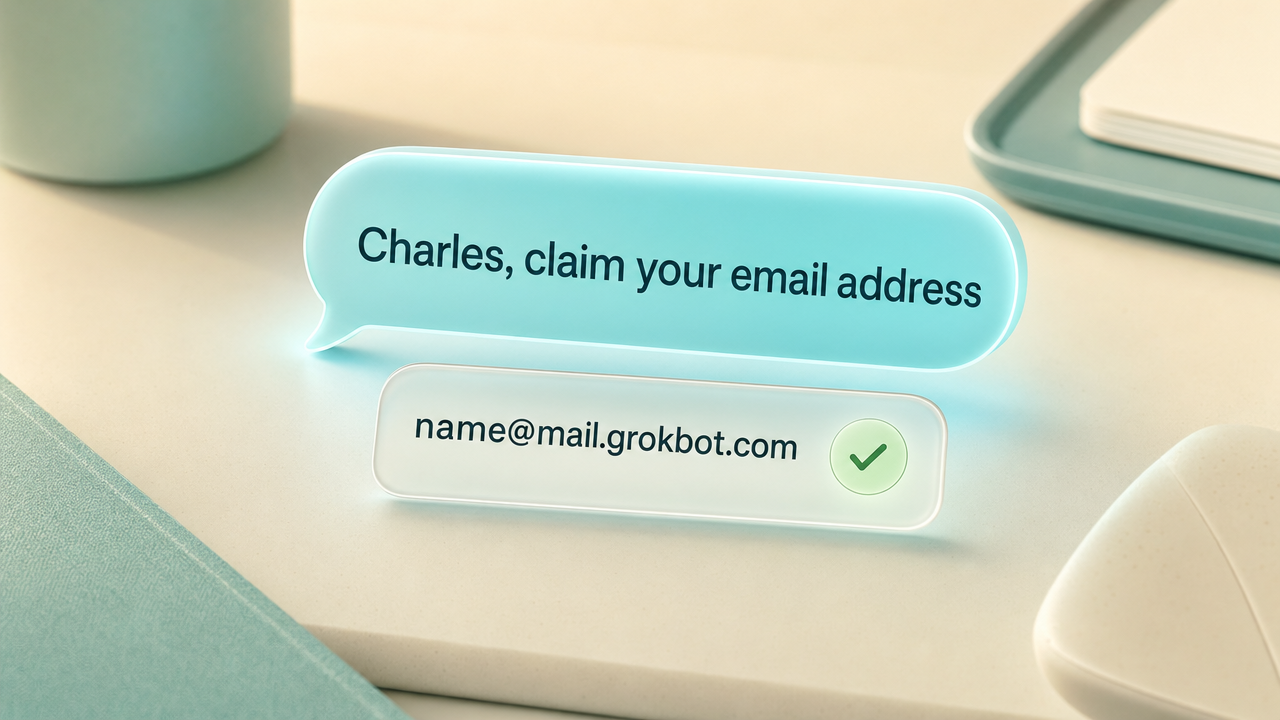
    • One sentence to start. You ask the Bot to claim its email. Addresses end in @mail.grokbot.com, and you can request a custom name if it is free.

    When you give your assistant its own email address, you can hand it the repetitive tasks, and you get time back for your family and the things you love.

    How your team can use it

    • Operations: “Claim your email address, then write to this supplier and ask for a quote on 200 units of SKU-14, delivery to our warehouse next month.” You review the draft or the reply instead of starting from a blank email.
    • Sales: “Use your email to book a 20-minute call with this prospect next week. Offer Tuesday or Thursday afternoon.” The calendar dance leaves your inbox alone.
    • Support: “Sign up for this returns portal with your email.” The signup mail goes to the Bot’s inbox, not yours.
    • HR: “Email this training venue and ask for three available dates for a 12-person workshop.” You pick from the options, not from a pile of unread mail.
    • Managers: “Schedule a 30-minute check-in with this contractor for Friday morning.” The Bot handles the back-and-forth until the time is set.

    If you also draft everyday replies yourself, see how to use ChatGPT to draft reply emails faster. For picking the right model behind each Grok Bot job, see how to use Grok Bot to get the best AI model for every work task.

    Before vs now

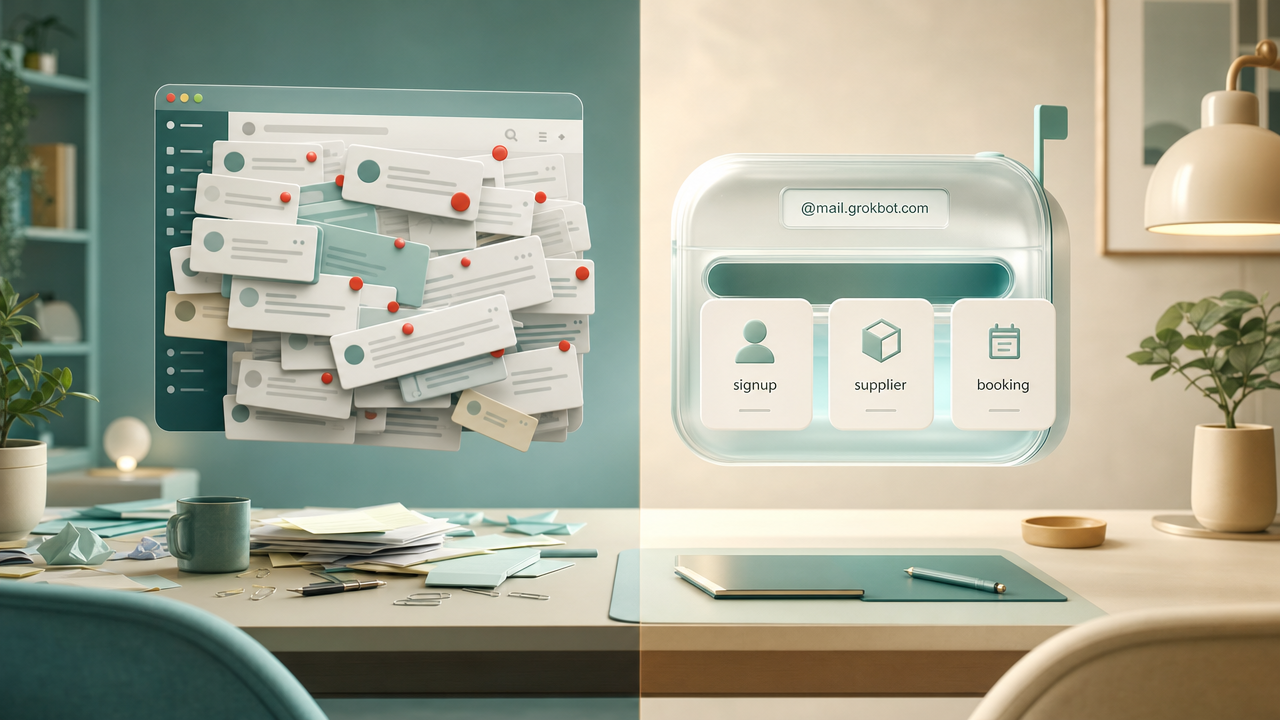
    • Last month: every signup confirmation, supplier reply, and booking ping landed in your inbox. You chased threads between meetings.
    • Now: the Bot has its own @mail.grokbot.com address. You hand it the loop in plain language. Replies come back to the Bot, and you only step in when something needs a human decision.
    Split desk: cluttered personal inbox on the left, calm @mail.grokbot.com mailbox with signup, supplier, and booking cards on the right

    How to claim your Grok Bot email

    Ten minutes, start to finish.

    1. Open your Grok Bot chat.
    2. Type this exact line: Claim your email address.
    3. Pick a free name. Short and work-safe works best, like your Bot’s name. The Bot checks whether it is available, and you end up with an address like yourbot@mail.grokbot.com.
    4. Tap Allow once to approve the claim.
    5. On a team plan, ask your admin to enable Bot email first if the claim fails.
    6. Then hand off one real loop: Using your new email, write a short note to this supplier asking for a quote on [item] by Friday. Show me the draft before you send.
    7. Read the draft. Approve or edit. Let the reply land in the Bot’s inbox, not yours.

    Choose the name with care: the name you pick is your Bot’s address from then on.

    Chat bubble reading Charles, claim your email address above a confirmation card with name@mail.grokbot.com

    If you cannot open Grok Bot right now, you can also tag @bot on X and ask it to set the inbox up, per the rollout post.

    Honest limits

    • What it may send in your name. Outgoing mail from the Bot represents you or your team. Start with “show me the draft before you send” until you trust the loop.
    • One inbox per Bot is not confirmed. The announcement talks about “its own email” and “your inbox”. SpaceXAI has not said whether every Bot you create gets a separate address, or whether the inbox follows the user. Treat it as one address for your setup until the docs say otherwise.
    • Team plans need an admin. If you work inside a company seat, an admin must enable the feature before you can claim.
    • No separate price announced. SpaceXAI did not list an add-on fee for Bot email. Grok Bot itself sits on paid Cursor plans from about $20 a month, or a linked SuperGrok account. Confirm the current plan page before you buy.

    Who can use it now

    Checked on 1 November 2026 against the @bot rollout posts and press walkthroughs:

    Who What you need Notes
    Individual Grok Bot users Ask your Bot, or tag @bot on X Rolling out from 9 October 2026
    Team / company seats Admin enables Bot email, then you claim Claim fails until the admin switch is on
    Address format @mail.grokbot.com Custom name if available (per 9to5Mac)
    Extra fee for email None announced Grok Bot is bundled with Cursor / SuperGrok plans

    Quick questions

    How do I claim a Grok Bot email address?

    In your Grok Bot chat, type “Claim your email address”, pick a free name, and tap Allow once. You can also tag @bot on X. On a team plan, an admin must enable the feature first.

    What can Grok Bot do with its email?

    The announcement names three jobs: sign up for services, contact businesses for you, and schedule time with someone. Anything beyond that is not documented yet.

    Does every Bot get its own inbox?

    SpaceXAI has not said. Until the docs cover it, treat the inbox as one address for your user setup, not a guaranteed address per Bot name.

    Is Grok Bot email free?

    No separate email fee was announced. You still need a Grok Bot seat on a paid Cursor or SuperGrok plan. Check the current plan page for the exact price.

    Sources

    For a wider look at desktop AI agents in the office, see best AI agent for desktop workflows in the office. And when the same chase note keeps landing back on your desk, automate follow-up emails without code so the sequence keeps moving without a developer.

    robotshelp Launchpad (free): step-by-step lessons to let AI do the boring part of your work.

    No password needed – your reset opens instantly.

  • How to Use ChatGPT to Draft Reply Emails Faster

    Your inbox is full of messages that need a clear answer, not another hour of rewriting the same polite opener. This guide shows how to use ChatGPT to draft reply emails faster so you paste the thread, get a usable draft, and send after a short human check.

    Imagine it’s 4:40 pm, twelve replies still open, and in the next few minutes each one has a solid first draft in your voice instead of a blinking cursor.

    No password needed, your reset opens instantly.

    No password. Just your email, and you’re in.

    Short answer: paste the email you need to answer, tell ChatGPT the outcome you want and the tone to keep, then edit names, dates, and promises before you send. OpenAI’s own ChatGPT Work examples include finding emails that need attention and drafting replies in your voice while leaving them unsent for review (Get your email to inbox zero).

    Paste the email, ask for the reply you need

    Open a fresh chat so this thread does not mix with yesterday’s project notes. Paste the incoming message (or the last two turns if context matters). Add three short lines of your own:

    • Who you are in this thread (role or relationship)
    • What “done” looks like (approve, decline, propose a time, ask one clarifying question)
    • What you will not promise (budget, legal wording, or anything you have not checked)

    That paste-and-reply workflow is enough for most day-to-day mail. You are not asking ChatGPT to invent a company policy. You are asking it to turn a clear intent into sentences you can skim.

    If the thread is long, paste only the parts that change the answer. Many people find a short excerpt plus one sentence of context beats dumping the whole history.

    Brand new to ChatGPT? Start with our ChatGPT tutorial for beginners to set up your account and write your first work prompt, then come back here.

    A prompt that keeps your tone

    Tone is where a ChatGPT email reply draft often goes wrong. Too stiff, too chipper, or full of phrases you never use. Give ChatGPT a short sample of how you write, then lock the rules.

    You are helping me draft a reply email in my normal work voice.
    
    My role in this thread: [your role]
    Desired outcome: [approve / decline / propose times / ask one question / confirm next step]
    Tone: clear, warm, no hype. Short paragraphs. No exclamation marks unless I use them in the sample below.
    Hard rules:
    - Do not invent facts, dates, prices, or commitments I did not state.
    - If something is missing, put [NEED FROM ME] in brackets.
    - Keep the reply under 180 words unless I ask for more.
    - End with a simple next step the other person can answer in one line.
    
    Sample of how I write:
    [paste 3 to 5 sentences from a real email you sent]
    
    Incoming email:
    [paste message]
    
    Write the reply only. No preamble.

    Save that block as a note on your desktop. Faster email replies with ChatGPT usually come from reusing the same shape, not from rewriting the prompt every time.

    Want a ChatGPT reply to email template for a common case (meeting reschedule, “thanks, noted”, polite no)? Ask for two variants in the same chat: one short, one slightly warmer. Pick the closer one and edit once.

    Fix the draft in 30 seconds (what to check)

    Treat the draft as a first pass, not a send button. Spend half a minute on this checklist:

    1. Names, titles, and company spellings
    2. Dates, times, and time zones
    3. Any promise you did not mean to make
    4. Links or attachments you still need to add yourself
    5. Tone: would you say this out loud to that person?

    If the draft feels generic, tell ChatGPT one concrete detail to weave in (“mention we already shipped the sample on Tuesday”). One follow-up beat usually fixes it.

    If the reply reads a little too casual for the person on the other end, the prompts in make this email sound more professional tighten the tone while keeping your facts and your voice.

    When the reply is ready, copy it into your mail client. Do not paste secrets into ChatGPT that your company forbids in third-party tools. Redact account numbers and private personal data first.

    When not to auto-reply

    Some messages deserve a human first draft, or a human-only reply:

    • Conflict, complaints, or anything that could become a record in a dispute
    • Salary, health, or other sensitive personal topics
    • Legal, compliance, or security incidents
    • Anything where a wrong date or wrong yes would cost real money

    In those cases you can still ask ChatGPT to outline options or tighten your own wording after you write the core answer. Keep the judgment with you.

    If your workplace connects mail apps inside ChatGPT Work, the same review rule applies. Drafts stay unsent until you approve them, which matches how careful desk work should feel.

    Working in Gmail with a Google Workspace account? You can do the same thing without copy and paste. See how to use Gemini in Gmail.

    Turn it into a repeatable habit

    Speed compounds when the habit is boring and reliable:

    1. Keep one pinned prompt with your tone sample.
    2. Batch replies twice a day instead of answering every ping.
    3. For recurring mail (status updates, scheduling), keep a small set of starter outcomes you reuse.
    4. After you send, glance once: did the other person understand the next step? If not, tighten the closing line in your prompt.

    If you also leave meetings with messy notes, pair this with a structured summary habit so the follow-up email writes itself from clean decisions and owners. See how to use ChatGPT to summarize meeting notes.

    When the reply work sits next to other desk tasks, it helps to pick the right tool for the job rather than forcing one model to do everything. Our Grok Bot best model per task guide is a practical picker for that. For broader office workflows on the desktop, read best AI agent for desktop workflows in the office.

    If most of those replies are customers asking the same few questions, you can go one step further and automate customer support with AI agents that draft the answer and hand anything tricky back to you.

    You do not need a perfect system. You need a paste-and-reply workflow you trust, a prompt that sounds like you, and a thirty-second check before send.

    If the reply depends on a long report or deck, pull decisions and owners first with how to use Claude AI to summarize a long report and extract action items, then draft the email.

    If follow-ups keep slipping because every chase is written by hand, automate follow-up emails without code and let the sequence run while you stay on real replies.

    Ready for short, practical lessons that fit real desk work?

    No password needed, your reset opens instantly.

    No password. Just your email, and you’re in.

    Want the draft to leave your inbox without copy-paste every time? Pair this with Zapier free plan automation examples that keep the flow at one trigger and one action.

    If the job is a multi-touch outreach sequence rather than one reply, see ChatGPT for sales outreach sequences for a paste-ready cadence you can keep editing in ChatGPT.

    When the reply needs a reusable pattern for proposals, check-ins, or tough client news, start from ChatGPT for client communication templates and adapt the template to your voice.

    If the next step is a full bid rather than a short reply, open ChatGPT for proposal writing for freelancers and build the scope, timeline, and ask in one desk session.

    For support-desk wording beyond everyday inbox replies, see also ChatGPT prompts for customer support agent work.

    Once your replies are faster, the next step is letting the routine mail handle itself. Browse these email automation examples for eight workflows that sort, flag and draft mail for you, with drafts first so you stay in control.

    When the message you need to answer is a Google review rather than an email, follow how to use AI to respond to Google reviews to draft a short public reply you still check and post yourself.

  • How to Use ChatGPT to Summarize Meeting Notes

    Your meeting ended ten minutes ago, and the notes look like a pile of half-finished sentences. You still need a clear summary, who owns what, and a follow-up you can send without rewriting everything by hand. This guide shows how to use ChatGPT to summarize meeting notes so you leave with decisions, owners, and next steps you can trust.

    Imagine it’s 3 pm, three meetings still to go, and one minute from now your messy transcript turns into a one-page brief with named owners and due dates.

    When the follow-up is a reply sitting in your inbox, the same paste-and-check habit helps: how to use ChatGPT to draft reply emails faster.

    No password needed, your reset opens instantly.

    No password. Just your email, and you’re in.

    Short answer: paste or upload the notes (after you strip private details), ask for a structured summary with decisions and action items, then check names and dates before you share. OpenAI’s help docs confirm you can attach documents or audio and ask ChatGPT to summarize, including meeting recordings with decisions and next steps (Uploading files and audio to ChatGPT).

    What you need before you paste anything

    Treat the chat like a shared desk drawer. Do not paste passwords, personal health details, salary numbers, customer secrets, or anything your company forbids in third-party tools. Many teams allow high-level project notes in ChatGPT; others require a work or enterprise plan with admin controls. When you are unsure, redact names of sensitive clients and replace numbers with placeholders.

    Gather one clean input:

    • Your typed notes from the call
    • A transcript export from Teams, Zoom, or Google Meet
    • A short .docx or .txt file you upload instead of pasting a wall of text

    If the transcript is full of “um” and speaker labels, keep it. ChatGPT handles messy text better than you might expect, as long as you tell it what format you want back.

    How to use ChatGPT to summarize meeting notes (step by step)

    Open a new chat so this meeting does not mix with last week’s project. Then:

    1. Paste the notes, or attach the file with the paperclip / plus control.
    2. Add a short context line: who was in the room, what the meeting was for, and what “done” looks like for you.
    3. Ask for a fixed structure every time (see the prompt below).
    4. Skim the output. Fix wrong names, vague owners, and missing dates yourself.
    5. Ask one follow-up: “Draft a short email to the group with the decisions and action items.”

    Reuse the same structure weekly. Your brain learns the shape of a good summary, and you spend less time rewriting the prompt.

    A prompt that returns summary, decisions, and owners

    Copy this, then drop your notes underneath:

    You are helping me turn meeting notes into a desk-ready brief.
    
    Meeting purpose: [kickoff / weekly sync / decision call]
    Attendees: [names or roles]
    
    From the notes below, produce:
    1) 5-8 bullet summary (facts only, no fluff)
    2) Decisions made (bullet list; if none, say “None recorded”)
    3) Open questions still unresolved
    4) Action items table: Owner | Task | Due date | Depends on
    Rules:
    - Invent nothing. If a due date is missing, write “TBD” and flag it.
    - Prefer real names from the notes; if only a role appears, keep the role.
    - Keep the whole reply under 400 words.
    
    Notes:
    [paste notes or transcript here]

    That single prompt covers both a readable summary and how to use ChatGPT to turn meeting notes into action items without a second page of instructions.

    How to use ChatGPT to turn meeting notes into action items

    Action items fail when they are wishes, not tasks. After the first reply, send a second message:

    Rewrite the action items only.
    Each row must have one owner, one verb-led task, and a due date or TBD.
    Split any item that has two owners.
    Mark items that need a decision before work can start.

    Then move the table into your tracker or calendar. ChatGPT drafts; you assign. If you are comparing tools for multi-step desk work later, our guide on the best AI agent for desktop workflows in office shows when chat-only help stops being enough.

    Cleaning messy notes and long transcripts

    Raw transcripts are noisy. Ask ChatGPT to ignore filler words, merge duplicate points, and group by topic before it summarizes. A useful follow-up:

    Clean the transcript first: remove filler, merge repeats, keep speaker labels when they matter for ownership. Then run the same four-part brief.

    For a one-hour call, many people find it helps to summarize in chunks (first half, second half) and then ask for a combined brief. That keeps important decisions from getting buried in chat limits or long context.

    No transcript at all, only a recording? This guide on how to transcribe audio with AI walks through free and paid ways to turn the audio into text first.

    If the notes arrive as a long PDF, like a board pack or exported minutes, this guide to analyzing long PDF files with Claude shows how to pull out decisions with page numbers.

    For a training manual or handbook you will open again, this guide to turning a PDF into notes with Claude builds an outline and glossary you can reuse.

    Draft the follow-up email from the same notes

    Once the brief looks right, stay in the same thread:

    Draft a short follow-up email (under 180 words) to attendees.
    Tone: clear and friendly, not corporate.
    Include: 3 key outcomes, the action items with owners and dates, and one line asking people to reply if something is wrong.
    Subject line options: give me three.

    Edit the draft in your own voice before you send. The goal is a pasteable start, not a finished identity swap.

    Common mistakes that waste the summary

    • Vague owners. “Team to follow up” is not an action item. Name one person.
    • No next step. A summary without decisions or tasks is a diary entry.
    • Pasting secrets. Strip credentials and private data before the chat.
    • Blind trust. Models can invent a date or merge two people. Spot-check against your memory or the recording.
    • A new prompt every week. Save your template so quality stays steady.

    If you later pick models inside a multi-model workspace, how to pick the best model per task in Grok Bot is a useful sibling read. For voiceover work after the meeting (training clips, explainers), see Suno Speech for training voiceovers.

    If most of your meetings already live in Google Meet, you may not need to paste notes into ChatGPT at all. Gemini can write them during the call with Take notes for me, then help you summarize that doc and pull action items. See how to use Gemini for meeting notes if you want that Google path instead of a copy-paste workflow.

    A weekly workflow you can reuse

    1. End the meeting with one person owning the notes file.
    2. Within an hour, paste or upload into ChatGPT with the template above.
    3. Confirm owners and dates in two minutes of human review.
    4. Send the follow-up email draft, then copy action items into your tracker.
    5. Save the prompt in a note titled “Meeting brief” so next Monday is copy-paste.

    That rhythm is how to use ChatGPT to summarize meeting notes without turning every call into an afternoon of rewriting.

    Quick checklist before you hit send

    • Private data removed from the paste or upload
    • Summary matches what you heard (no invented decisions)
    • Every action item has one owner and a date or TBD
    • Follow-up email is short enough people will read it
    • Tracker updated so the chat is not the only record

    When the pile is a long report or PDF instead of meeting notes, the same summary-plus-owners habit works in Claude. See how to use Claude AI to summarize a long report and extract action items.

    When those owners and dates need to leave the chat and land as a short recurring update, see Gemini for automated status updates.

    If someone who missed the meeting needs a proper write-up rather than a summary, here is how to turn meeting notes into a report people can act on.

    Good notes start before the meeting does. Next time, use AI to create a meeting agenda with a clear goal, time boxes and the decisions you need, so the summary almost writes itself.

    If the decisions happened in a Slack thread instead of a meeting, use this ChatGPT prompt for action items from a Slack thread to pull out owners, deadlines, and the message that proves each one.

    If you would rather capture decisions live instead of cleaning notes later, start with our comparison of the best AI note taker for meetings.

    Want guided practice on desk workflows like this? Launchpad walks you through practical AI steps with No password. Just your email, and you’re in.

    No password needed, your reset opens instantly.

    No password. Just your email, and you’re in.

  • Best AI Agent for Desktop Workflows in the Office (Practical 2026 Guide)

    Your inbox, spreadsheet, and browser tabs all need attention before lunch. You do not need another chatbot that only answers questions. You need the best AI agent for desktop workflows in office work: something that can pull from your files, click through apps when needed, and hand you a finished draft you can check.

    Imagine it’s 10:15. You ask one agent to turn yesterday’s meeting notes into a one-page brief, update the tracker row, and draft the follow-up email. By the time you refill your coffee, the three pieces are ready to review.

    Want that kind of desk help without the hype? Join Launchpad free. Step-by-step lessons that show you how to use AI for real work.

    No password needed – your reset opens instantly.

    No password. Just your email, and you’re in.

    Short answer: for most office desks in 2026, start with the ChatGPT desktop app and ChatGPT Work when you need multi-step work across files and connected apps. Treat “agent” as a job description, not a brand. The best fit depends on whether your task lives in chat, in local apps, or in a tool that already routes models for you.

    What “best AI agent for desktop workflows in office” really means

    People search this phrase when chat-only AI stops being enough. An office desktop workflow is a chain: open a file, read a thread, update a sheet, write a reply, maybe move a folder. A useful agent does more than answer. It stays with the job, asks when stuck, and returns something you can ship after a quick check.

    That is different from a single clever prompt. OpenAI describes ChatGPT Work as an agent that can gather information across apps and workflows, create finished materials like sheets, slides, and docs, and stay with complex projects by breaking them into smaller steps. On desktop, Computer Use can operate graphical apps when a plugin or API is not enough, per OpenAI’s Computer Use guide.

    Older “ChatGPT agent” mode is being steered toward Work for longer tasks. If you still see agent wording in help docs, read the date and prefer the current Work and desktop paths.

    How to choose: three practical options for desk work

    You do not need every tool. Pick by where the work already lives.

    1) ChatGPT Work + desktop app (best default for many offices)

    Use this when your day sits in email, Drive or SharePoint, Slack or Teams, calendars, and local files. OpenAI’s product page says the desktop app can use local files and apps, includes a built-in browser for web-based work, and offers Computer Use for clicking and typing across apps when you approve it. Scheduled Tasks can repeat checks or updates so you are not babysitting every step.

    Good first tasks:

    • Turn a messy meeting transcript into action items and owners.
    • Build a one-page brief from three PDFs already on your machine.
    • Draft a reply email from a thread summary, then you send it.

    If you only need a clean summary and action list from notes you already typed, start with how to use ChatGPT to summarize meeting notes.

    Stay in control. Approve app access narrowly. Prefer a plugin or connector when one exists. Save Computer Use for UI-only steps. On Windows, expect the agent to take the foreground while it works, so plan a short block or use a secondary machine if you need to keep typing elsewhere.

    2) Grok Bot when you want model routing without picking models

    If your friction is “which model should I use for this task?”, a routed bot can help. RobotsHelp already covers that angle in detail: how to use Grok Bot to get the best AI model for every work task. That page is about routing and safe try-outs, not about clicking through Excel for you. Pair it with ChatGPT Work when the hard part is multi-app execution, not model choice.

    3) Claude or Gemini when your stack already lives there

    If your team already works in Claude Projects or Gemini inside Google Workspace, do not rip that out for a brand name. Use the agent or side-panel features you already have for long documents, Sheets, and Slides. The “best” agent is the one your IT already allows and that you will open every morning. Soft rule of thumb: stay inside the suite that holds your files, then add a desktop agent only for gaps.

    A simple decision table for busy professionals

    Your situation Start here Why
    Files and apps on your own PC or Mac ChatGPT desktop + Work Local files, browser, optional Computer Use
    Heavy Google Workspace day Gemini side panel first Docs, Sheets, Slides already open
    Long PDF or report in Claude Claude Projects / document chat Strong for long reading and rewrite
    Unsure which model fits the task Grok Bot routing Less time spent model-shopping
    Training video needs a voiceover Suno Speech workflow See our Suno Speech training voiceover guide

    A 20-minute test you can run this week

    Do not buy a stack after reading a blog post. Run one real task.

    1. Pick a boring job you already know: weekly status email, meeting-notes cleanup, or a short competitive one-pager.
    2. Collect the source files in one folder. Remove anything confidential you should not feed an AI tool under your company policy.
    3. In ChatGPT desktop (or your allowed tool), describe the outcome, not the vibe. Example: “Read these three notes. Make a one-page brief with decisions, open questions, and owners. Draft a five-sentence email I can send to the team.”
    4. Watch the first run. Correct the format once. Ask it to reuse that format next time.
    5. If a step needs a desktop UI with no connector, try Computer Use on a low-risk app first, with you present.

    Many people find the second run is where time savings show up, because the format is already settled.

    Safety habits that keep you employed

    Agents that can click and read screens are powerful and risky. OpenAI’s Computer Use guidance is clear: keep tasks narrow, review permission prompts, avoid secrets unless you are present, and stop the run if the wrong window is in focus. For web and connected apps, assume anything visible can be treated as context.

    • Never paste passwords into the chat. Use takeover or manual login when asked.
    • Enable only the apps needed for this task.
    • Skip vague prompts like “handle my email.” Name the outcome and the stop point.
    • Check company policy before connecting Drive, mail, or CRM.

    What “best” looks like after one month

    The winner is not the flashiest demo. It is the agent you trust for three recurring workflows: meeting follow-up, document cleanup, and a weekly status pack. Track minutes saved on those three only. If a tool cannot finish a draft you would send with light edits, it is not your office agent yet.

    If you want guided practice instead of another tab of theory, Launchpad walks through practical desk tasks with ChatGPT, Claude, Gemini, and related tools. No password. Just your email, and you’re in.

    No password needed – your reset opens instantly.

    No password. Just your email, and you’re in.

    Email replies are another desk task the same agents can speed up. If your inbox is the bottleneck, see how to use ChatGPT to draft reply emails faster.

    For chase notes that should go out on a schedule without a custom stack, automate follow-up emails without code and keep the pipeline warm from your desk.

    If a big part of your day is answering customer questions, the same agent idea works for a support inbox. Here is how to automate customer support with AI agents without code.

    Want an agent that runs in the cloud on its own, sorting email or screening leads while your laptop is closed? Here is how to pick a no code AI agent builder that fits the apps you already use.

    Torn between a self-hosted assistant you message from chat and a coding agent that works in your files? Our OpenClaw vs Claude Code comparison puts cost, setup and safety side by side.

    If the work is desk deliverables rather than code, spreadsheets, reports, decks, compare OpenClaw vs Claude Cowork instead.

    Picked OpenClaw and working on a Windows PC? Here is how to install OpenClaw on Windows, step by step, from the Windows Hub app to PowerShell and WSL2.

    Sources

    For lighter no-code glue between the tools you already use, skim Zapier free plan automation examples aimed at desk work under the Free plan limits.